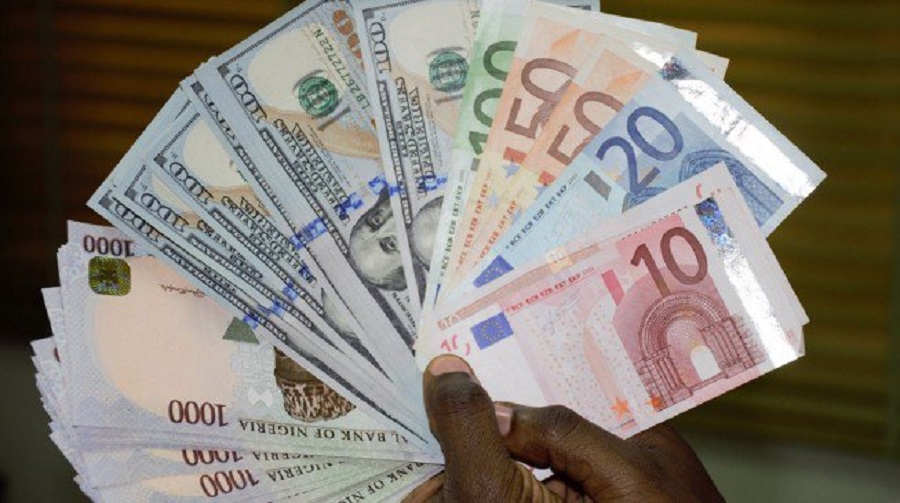


The naira extended its rally last week, closing at ₦1,465/$ on the official market, driven by a weaker U.S. dollar—following soft U.S. economic data and a government shutdown—and stronger foreign exchange inflows that reduced demand pressure.
Similarly, in the parallel market, the currency appreciated by 3.8% week-on-week to ₦1,460/$, narrowing the gap between the two markets to -₦5.68/$ from ₦34.34/$.
Analysts say this reflects easing speculative pressure and renewed confidence in the official market.
In its weekly report, AIICO Capital attributed the robust liquidity inflows to increased participation from offshore investors and International Money Transfer Operators.
“Last week, the FX trading opened with a strong dollar supply, pushing rates to 1,475.35/$. Midweek, steady interventions and improved flows anchored the market within the 1,445–1,468/$ band, containing volatility.
“By week’s end, the naira strengthened modestly on sustained dollar supply and tempered demand, closing at 1,465.68/$, up 101 bps w/w,” the company said.
The naira also remained resilient despite falling global oil prices, reinforcing views of a growing disconnect between the currency and oil market trends.
Although oil prices closed slightly higher on Friday, they recorded a weekly loss of 8.1% following reports of possible OPEC+ supply increases. Brent crude and WTI are both headed for their sharpest monthly declines in four months, with Brent at $64.53 per barrel (-8.3% week-to-date) and WTI at $60.86 per barrel (-7.6% week-to-date).
Nigeria’s Bonny Light crude dropped 4.66% to $69.94 per barrel, heightening concerns about potential revenue pressures and wider fiscal challenges if oil prices remain subdued in the near to medium term.
Experts noted that market sentiment remains cautious, as expectations of an additional 500,000 barrels per day (bpd) output increase could worsen the existing supply glut.
Those concerns were confirmed on Sunday when Saudi Arabia, Russia, and six other OPEC+ members agreed to raise their production quotas by 137,000 bpd in November, as part of efforts to expand their market share.
Looking ahead, analysts expect the naira to sustain its positive momentum across foreign exchange segments, buoyed by ongoing interventions from the Central Bank of Nigeria.